Seafood & fisheries · Typical for: West Africa, South Asia & Southeast Asia
Seafood Blast Freezer and Frozen Store for a Fishing Port
Reference design for a fishing port: a −35 °C blast freezer for daily catch plus a −20 °C frozen store, with semi-hermetic units and DJ-type evaporators.

The challenge
Fishing ports often land most of their catch in a few hours, usually early in the morning, in hot and humid conditions. Fish left on the quay or in poorly iced boxes loses quality fast, and a conventional cold store cannot freeze large warm loads without warming the product already in storage.
Sites are typically coastal, with salty air that corrodes condensers and fins, and power supplies that may fluctuate. Local service capability can be limited, so equipment must be robust and repairable.
The engineered solution
Two-room layout
The blueprint separates freezing and storage. A dedicated blast freezer handles the daily batch, and a larger frozen store holds finished product until shipment. Each room has its own condensing unit, so a fault in one does not stop the other.
Blast freezer
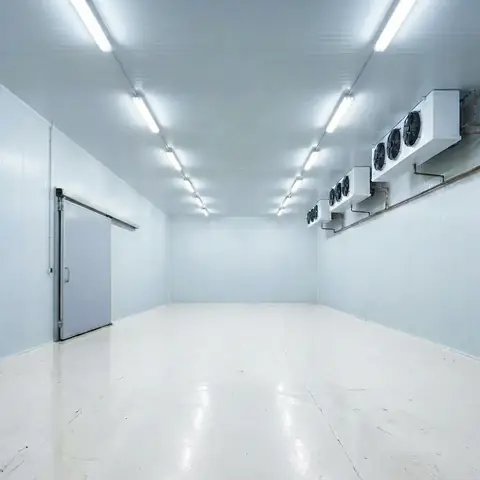
- 150 mm PU panels with insulated, heated floor and frost-heave protection.
- High-static air coolers and baffles that force air through trolleys of trays.
- Semi-hermetic compressor selected at about −42 °C evaporating and high ambient condensing temperature.
Frozen store
- 120 mm PU panels, DJ-type evaporators with electric defrost and heated drains.
- Strip curtain and fast door discipline to limit infiltration during loading.
Coastal protection
- Coated condenser and evaporator fins where salt exposure is high.
- Shaded, ventilated condenser area with clearances for cleaning.
- Phase-failure and voltage protection on all units.
Design targets
The system is designed to freeze a 3 t batch of fish from about +10 °C to −18 °C core within 8–10 hours, depending on product size and packaging, and to hold the frozen store at −20 °C at a design ambient of up to 43 °C.
Separate refrigeration circuits are intended to keep the frozen store running during blast freezer defrost or maintenance. Final capacity, batch time and power demand are confirmed in the project-specific load calculation.
Equipment list
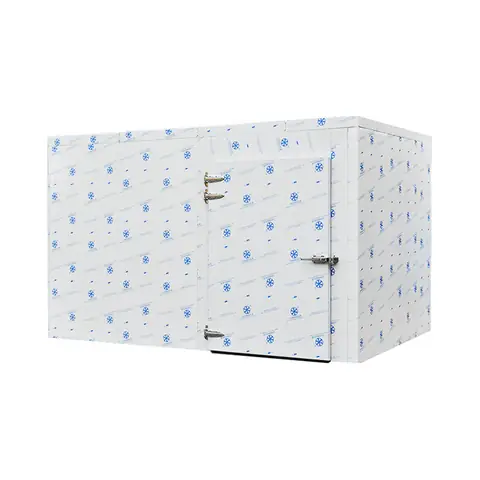
- 150 mm PU camlock panels for the blast freezer, 120 mm for the frozen store
- Open-type semi-hermetic piston condensing units, one per room
- High-static low-temperature air coolers with about 10–12 mm fin spacing for blast duty
- DJ-type evaporators with electric defrost for the frozen store
- FNH air-cooled condensers selected for high ambient
- Heated freezer doors, pressure relief valves, strip curtains and floor frost-heave protection
This is a reference blueprint. Final capacities and layouts are calculated for each site.
Equipment used in this blueprint
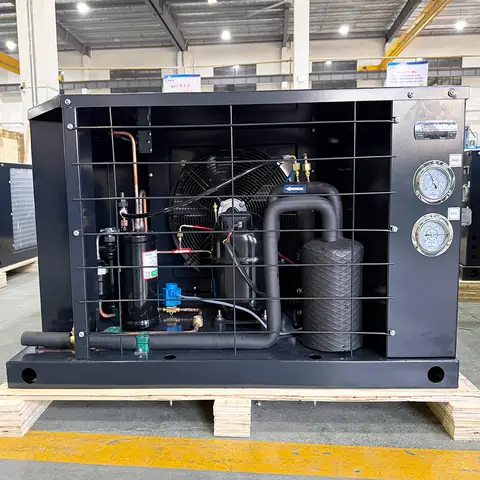
Semi-Hermetic Cold Room Condensing Unit, Custom Capacity
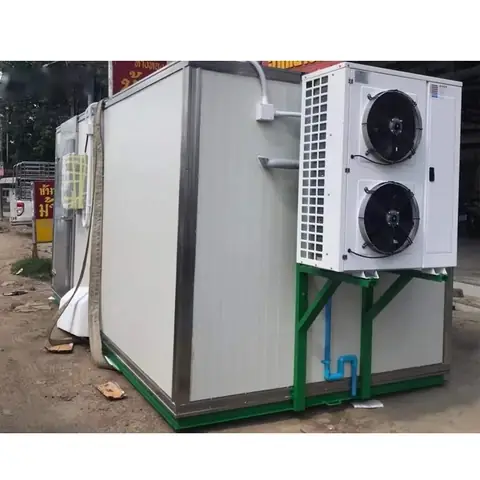
RX-FNL-10MH Condensing Unit, MLZ076 Compressor
More blueprints

Multi-Chamber Fruit and Vegetable Chiller Warehouse
Reference design for a fresh produce warehouse with four independent chiller chambers at 0 to +10 °C, low-TD evaporators and V-type condensers for hot sites.

40ft Container Mobile Cold Room for Remote Sites
Reference design for a 40ft container cold room for mining, construction and relief sites: plug-in chiller or freezer, generator-ready and easy to relocate.

Walk-In Chiller and Freezer Combo for Restaurants and Hotels
Reference design for a restaurant or hotel kitchen: a two-compartment walk-in with +2 °C chiller and −18 °C freezer, quiet box-type units and hygienic finish.
Tell us the room. We’ll engineer the rest.
Send size, temperature and product — get drawings, a matched equipment list and a quotation, usually within 24 hours on working days.